





Why NFL Key Numbers Can Make or Break Your Bet
NFL key numbers can turn a winning football prediction into a losing betting ticket. If you’ve ever backed a favorite that won by three but failed to cover -3.5, you’ve already paid tuition for this lesson.
Three and seven aren’t magic numbers. They’re the most common margins of victory in professional football, which makes them extremely important when betting point spreads. Knowing when to grab an extra half-point, when to accept a push and when to reject an expensive price can make a difference over a full NFL season.
I’ve spent enough Sundays around betting boards to know that picking the better team is only half the job. The other half is knowing what number you’re betting into.
I’m the resident handicapper around these parts. Welcome to another installment of our Sports Betting 101 guide, where I break down the betting lessons that can save you money and a few Sunday afternoon headaches. Today we’re talking about NFL key numbers, specifically why three and seven deserve your attention before you put a dime on the game.
Picking the right side is one thing.
Getting the right number?
That’s where a little knowledge can pay off.
What Are NFL Key Numbers in Sports Betting?
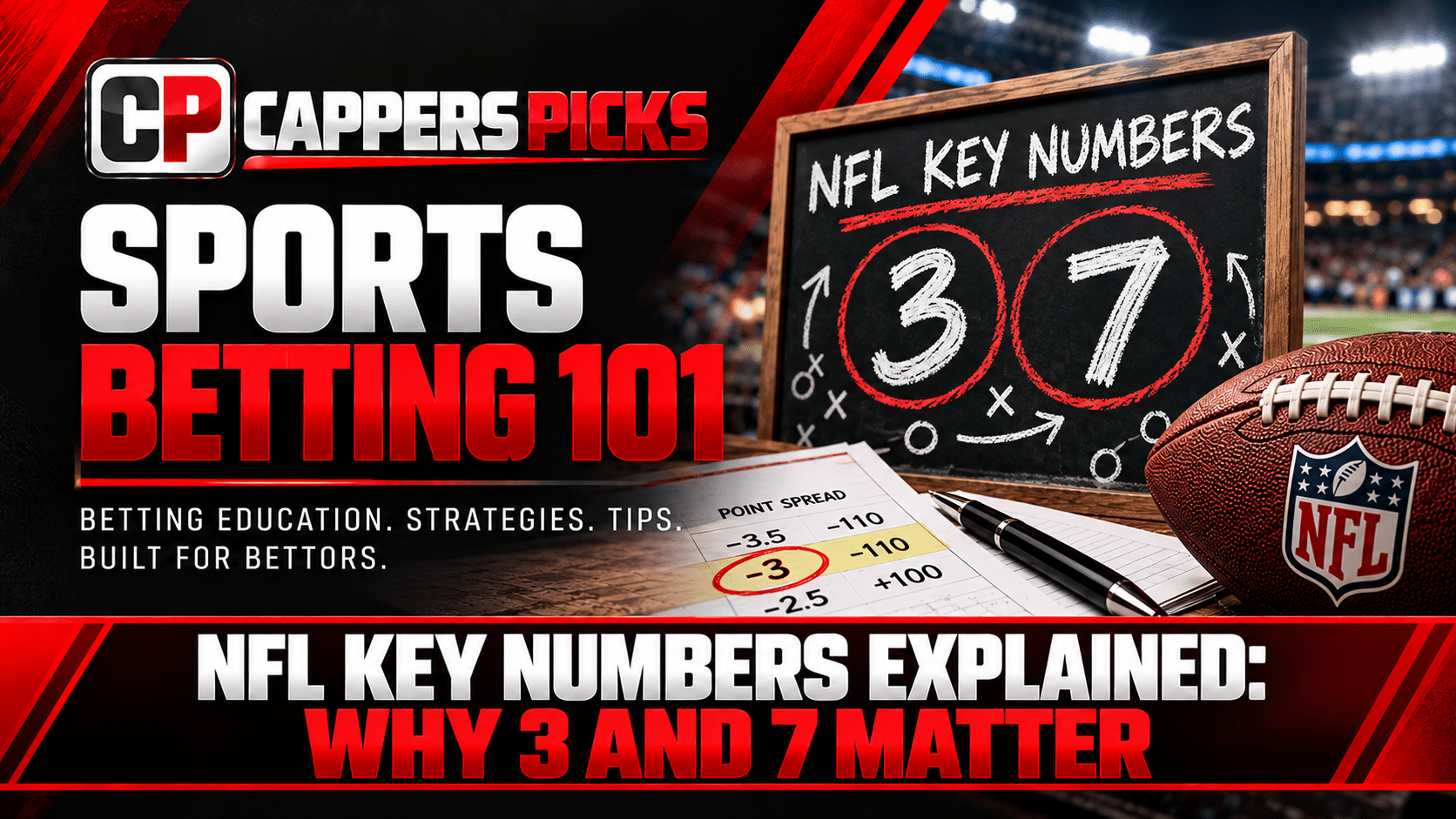
Key numbers are final victory margins that occur more frequently than others. In the NFL, the biggest are 3 and 7, followed by numbers such as 6, 10 and 14. They matter because football scoring follows patterns, and certain combinations show up much more often than others.
A field goal produces three points, while a TD followed by a successful extra point produces seven. The way points accumulate helps explain why certain victory margins appear so frequently.
Consider these familiar NFL finals:
- 24-21 — a three-point victory.
- 27-20 — a seven-point victory.
- 23-17 — a six-point victory.
- 30-20 — a ten-point victory.
- 28-14 — a fourteen-point victory.
All five margins matter, but three and seven deserve special attention. A spread sitting directly on either number can produce a different result from one sitting a half-point above or below it. That’s where a seemingly harmless difference on the betting board starts affecting your bankroll.
Why 3 and 7 Matter More Than Other Margins
Three-point victories have historically occurred more often than any other individual NFL winning margin, with seven-point results also showing up regularly. Exact percentages vary by season and sample, but the importance of both numbers has remained a central part of football point spread betting.
Plenty of bettors spend hours debating QB matchups, defensive schemes and coaching tendencies, then shrug off half a point like it’s pocket change. Interesting way to protect a bankroll.
Why the Number 3 Matters Most
Three is the heavyweight champion of NFL point spreads. Field goals, close fourth quarters and teams protecting narrow leads help make it the most common final margin. It’s also the number that can make two bettors holding different versions of the same spread feel very differently about the final score.
Suppose a favorite wins 24-21. At -2.5, your ticket wins. At -3, it’s a push, while -3.5 loses.
Same game. Same handicap. Three completely different betting results.
Why the Number 7 Matters
Seven comes next because a TD and extra point remain a common scoring combination. Games ending 28-21 or 24-17 create the same problem for bettors holding the wrong spread.
With an underdog at +7.5, a seven-point loss cashes. At +7, it pushes. At +6.5, you’re tearing up the ticket.
That’s why a move from 6.5 to 7, or from 7 to 7.5, deserves a second look. The difference seems tiny until the final whistle, especially when a late TD or FG leaves the margin sitting right on that number.
How NFL Key Numbers Change Your Point Spread Bet
Here’s where the lesson gets practical. Imagine you like a favorite and find -3.5 at one sportsbook but -3 at another. Both wagers require the same team to win, but they don’t offer the same protection.
If that favorite wins by exactly three, the -3.5 ticket loses while the -3 ticket pushes. You’ve backed the same team, watched the same game and reached the same final score. One bettor gets a refund, and the other gets a loss.
| Point Spread | Favorite Wins by 3 | Favorite Wins by 4 |
|---|---|---|
| Favorite -2.5 | Win | Win |
| Favorite -3 | Push | Win |
| Favorite -3.5 | Loss | Win |
At identical odds, -3 is clearly better than -3.5 for the favorite. No sophisticated formula required.
But sportsbooks don’t always offer identical prices. One book might offer -3 at -125 while another has -3.5 at -110, and now the decision becomes more interesting. You have to weigh the value of the better spread against the extra juice you’re paying to get it.
A better number is valuable, but the price determines whether it’s worth taking.
Should You Buy Half-Points Around NFL Key Numbers?
Sometimes. But buying points blindly is a terrific way to hand your sportsbook extra money every Sunday.
Buying a half-point means paying a higher price to move your spread in your favor. For example, a sportsbook might offer an underdog at +2.5 (-110) or +3 (-130). The second wager provides protection against a three-point loss, but that protection comes out of your potential profit.
At +2.5, a three-point defeat loses. At +3, that same result becomes a push and your original stake comes back. That’s useful insurance, provided the price makes sense.
What Does Buying a Half-Point Cost?
Let’s compare two hypothetical bets using a $100 stake. These are examples, not current sportsbook odds.
| Bet | Stake | Profit if It Wins |
|---|---|---|
| Underdog +2.5 (-110) | $100 | $90.91 |
| Underdog +3 (-130) | $100 | $76.92 |
At -130, you’re giving up nearly $14 in potential profit for the extra half-point. That isn’t automatically a bad trade, but it isn’t automatically a good one either. You need to determine whether the chance of landing on three justifies sacrificing that payout on every winning ticket.
Here’s another detail bettors miss. The historical percentage of all NFL games ending by three doesn’t tell you the exact probability of this particular underdog losing by three. The matchup, expected scoring and original spread all influence that calculation.
When Buying Points Makes Less Sense
Moving from +4.5 to +5 generally offers less protection than moving from +2.5 to +3 because five-point margins occur less frequently than three-point margins. That makes the number you’re crossing just as important as the amount of movement you’re purchasing.
Sportsbooks know the value of three, too. They aren’t selling discounted insurance out of the goodness of their hearts.
Compare the original odds, the adjusted odds and the outcomes the extra half-point actually protects. If the math doesn’t support the purchase, there’s no reason to make it.
Using Key Numbers in Teaser Betting
Teasers offer another way to use key numbers. A teaser moves multiple point spreads in your favor, but every selection must satisfy the sportsbook’s settlement rules for the ticket to win. The extra points can be useful, although the payout is generally lower than combining comparable straight bets.
For example, a six-point teaser can move an underdog from +2.5 to +8.5. That adjustment crosses both three and seven, protecting against several common final margins.

CP Is More Than Just Sports Picks!
“ Anybody can post a prediction. CappersPicks backs up its sports picks with opinionated matchup analysis, experienced handicappers & documented betting performance. Pad that bankroll one day at a time! ”

Compare that with moving an underdog from +10.5 to +16.5. Both wagers gain six points, but they don’t cross the same concentration of historically common margins. That’s why some NFL teaser strategies focus on crossing three and seven rather than simply grabbing six points wherever they appear.
There’s a catch, naturally.
Teaser payouts vary, pushes can affect settlement, and tying multiple outcomes together creates another hurdle. A favorable-looking adjusted spread doesn’t automatically make the entire ticket a good bet. You still have to judge the full price of the wager, not just admire the extra points.
Five NFL Point Spread Mistakes Bettors Should Avoid
Understanding key numbers won’t fix every bad football bet. It will, however, help you avoid some expensive habits that have nothing to do with predicting the winner.
- Ignoring the hook. A spread of -3.5 is not interchangeable with -3. That half-point changes how a three-point win gets graded.
- Paying any price for protection. A better spread can still be a worse wager if the added juice costs too much.
- Comparing spreads without comparing odds. +3 at -145 isn’t automatically better value than +2.5 at -110.
- Treating every number equally. Moving across three generally matters more than moving across five.
- Forcing a bet because the spread looks attractive. A beautiful number on a game you haven’t handicapped is still a guess.
That last mistake gets people every weekend. They see a line they like, invent a reason to bet it and call the whole exercise handicapping. That’s not a system. That’s shopping with a gambling account.
A good betting decision starts with a football opinion, not an excuse to put action on television.
My NFL Betting Checklist Before I Take a Number
I start with the football game, not the betting board. I want to understand the QB situation, injuries, offensive efficiency, defensive weaknesses and how the teams are likely to attack each other. Those factors help me establish my own opinion before I see whether the sportsbook is offering something worth betting.
Next, I decide what spread and price I’d actually be willing to play. If my opinion supports a favorite at -2.5 but the available number is -3.5, I don’t automatically talk myself into laying the extra point.
Then I compare sportsbooks. I’ll check the spread, the juice and whether a nearby key number changes the outcomes my ticket can survive. Sometimes the better option is available at another book, and sometimes every available number is worse than the one I wanted.
In that second situation, I pass.
You don’t have to bet every televised game. The NFL schedule will survive without your contribution, and there will always be another matchup worth evaluating.
For more on evaluating betting opportunities, visit our sports handicappers section.
NFL Key Numbers FAQ
The numbers look simple enough until a game lands right on the spread. Here are answers to the questions football bettors ask most often about three, seven and buying points.
What are the most important key numbers in NFL betting?
Is -3 better than -3.5 in football betting?
Should I always buy a half-point in NFL betting?
Do NFL key numbers matter for college football?
Compare Sportsbooks Before Placing Your Next Bet
Getting the right spread is one thing. Finding a sportsbook that actually offers it is another. Our recommended offshore sportsbooks give bettors more places to compare NFL lines, odds and available promotions before making a decision.
Don’t settle for the first number on your screen when another book might have a better one.

- 50% Reload Bonuses
- Daily Player Promos
- Live Dealer Casino

- Crypto Deposits
- Same-Game Parlays
- Casino + Poker

- Same-Game Parlays
- Overnight Lines
- Progressive Jackpots

- Reduced-Juice Lines
- 7% Racebook Rebate
- 100% Crypto Bonus

- VIP Cash Rewards
- Live Betting & Props
- High Betting Limits
The Bottom Line on NFL Key Numbers
Three and seven belong on every NFL bettor’s radar. They can turn a win into a push, a push into a loss, or occasionally save a ticket you had no business cashing.
Learn which margins matter, understand the price attached to them and be willing to pass when the number isn’t right. Picking winners is hard enough without volunteering for a worse spread.
RAZOR RAY’S TAKE:
“I’ve watched bettors spend six hours handicapping an NFL game, then give away half a point because they couldn’t be bothered to compare two sportsbooks. That’s like doing all your homework and forgetting to put your name on the test. Three and seven aren’t lucky numbers. They’re numbers you need to respect. And here’s the part nobody likes hearing: sometimes the smartest bet is the one you don’t make. You can be right about a team and still be wrong about the wager. There’s a difference, and your bankroll knows it.”
Register here for a FREE betting account. Also check out our Linktr.ee!





Leave a Reply